When businesses review their shipping costs, they often focus on courier rates, product weight and packaging prices.
However, packaging size can also have a significant impact.
Using a box that is much larger than the product inside can mean storing more packaging, using more protective material and sending unnecessarily large parcels through the delivery network.
So, how much empty space are you actually paying for?
Why oversized packaging can create problems
A larger box might seem like a safe choice. After all, it gives you plenty of room for the product and protective material.
But excessive space can introduce several problems.
These include:
– More room for the product to move
– Greater use of void fill
– Larger parcels to store and handle
– Less efficient use of warehouse space
– More packaging material per shipment
The goal should not simply be to find a box that the product fits inside. Businesses should aim for packaging that provides enough room for effective protection without creating unnecessary empty space.
Parcel dimensions matter during shipping
Product weight remains important, but many delivery services also consider the dimensions of a parcel when calculating shipping requirements.
This means an unusually large lightweight parcel may not always be as economical as it first appears.
Reducing unnecessary parcel volume can therefore help businesses make better use of the space available throughout storage, packing and transport.
It can also make parcels easier for employees to handle at the packing station.
More empty space means more movement
The space inside the box also affects product protection.
If an item can move freely, every corner, sudden stop or impact during the delivery journey creates another opportunity for it to strike the inside of the carton.
Businesses often solve this by adding more void fill.
However, a better approach is to combine an appropriately sized outer box with internal packaging that holds the product securely in position.
This provides protection without filling large areas of unnecessary space.
Packaging size affects your warehouse too
The impact begins before you even ship the parcel.
Large boxes and bulky protective packaging take up valuable warehouse space. Businesses that ship hundreds or thousands of orders may need significant storage just for packaging materials.
At AirPack Systems, our inflatable protective bags arrive uninflated and remain compact until they are needed.
This means businesses can store large quantities of protective packaging without dedicating the same amount of space required for bulky pre-inflated alternatives.
Employees simply inflate the bags when they need them.
Right-sizing doesn’t mean reducing protection
Businesses should not interpret right-sizing as simply choosing the smallest possible box.
The product still needs enough cushioning to cope with the realities of storage, handling and transport.
When reviewing packaging size, consider:
– Product dimensions
– Product weight
– Fragile areas
– Required cushioning
– Movement inside the box
– The strength of the outer carton
The best packaging balances compact dimensions with reliable protection.
Could bespoke packaging help?
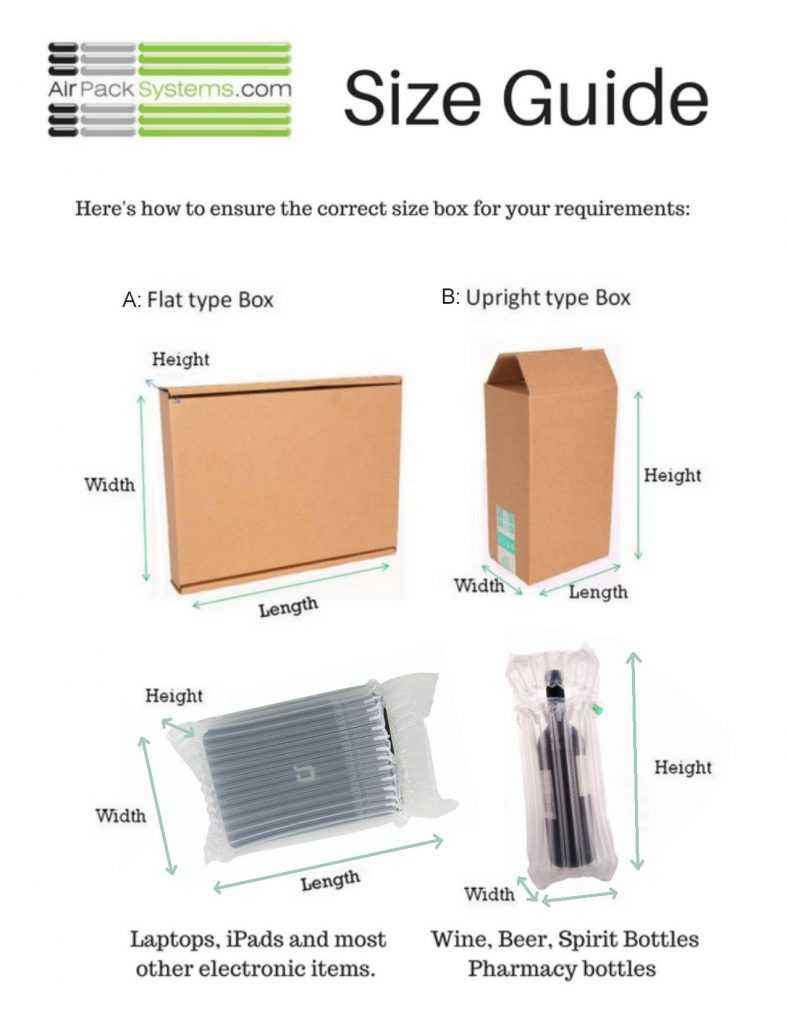
Some products simply do not fit standard packaging sizes very well.
Businesses may repeatedly use oversized boxes because no standard option provides the right fit.
In these situations, bespoke packaging solutions can create a better match between the product, its internal protection and the outer carton.
This can provide a more consistent packing process while reducing unnecessary empty space.
Final thoughts
Packaging takes up space at almost every stage of the supply chain — in your warehouse, at the packing station, inside delivery vehicles and throughout courier networks.
Reviewing your packaging size can help identify unnecessary empty space while improving the way products fit and remain protected inside their cartons.
The answer is not always to use less packaging. Instead, businesses should focus on using the right amount of packaging in the right places.
At AirPack Systems, we can help businesses find standard and bespoke protective packaging solutions designed around the products they need to ship.